
Lakeland City Directory Years and Shelves
Lakeland's historical directory trail is spread across digitized volumes, library databases, telephone books, and archival collections. Confirmed editions begin in 1915 and appear often through 1960. The research did not establish a complete physical run after 1960, so staff confirmation is the safe route for later books.
| Collection | Years | Where held | Access |
|---|---|---|---|
| Lakeland resident volumes | 1915, 1917, 1919, 1921, 1923-26, 1928, 1931, 1934, 1936, 1938, 1940, 1942, 1945, 1947, 1950, 1952, 1954-60 | Ancestry in library; FamilySearch catalog; Allen County digitization | Library, catalog, or digitized copy |
| Regional Polk/Lakeland editions | 1928, 1931, 1934 | NARA directory list | Research by regional edition |
| White and yellow pages | 1951 through October 1960 segments | Library of Congress digitized telephone directories | Online digitized volumes |
| Federal census schedules | Public through 1950 | NARA and library database access | Online or in library |
| Ledger obituary index | 1911-1975 and 1999-present | Lakeland digital special collections and History Room | Online index and staff help |
Many mid-century books follow an R. L. Polk & Co. format, but the title page of each scan should decide publisher credit. The known catalog title also describes a buyers' guide and classified business section. It may cover more than a simple alphabetical resident list.
Lakeland Directory Timeline, 1885 to 1960
Lakeland incorporated in 1885. Earlier residents must be sought through Polk County land, church, census, and civil records rather than municipal files. The sequence below shows why directory research grows stronger when paired with other dated collections.
| 1885 | Lakeland incorporates; city-era context begins. |
|---|---|
| 1915 | First confirmed Lakeland volume in the researched run. |
| 1928, 1931, 1934 | Regional editions include Lakeland and several other Polk municipalities. |
| 1951-1960 | Documented telephone-book segments add subscriber and business addresses. |
| 1960 | Last confirmed year in the directory list; later shelf coverage needs staff review. |
The 1890 federal population schedules were mostly destroyed nationwide. Local books, tax rolls, deeds, and newspapers therefore carry extra weight between the 1880 and 1900 census years. Full public census schedules currently end at 1950 under the federal 72-year rule.
The Florida State Library city directories resource adds a statewide shelf and research guidance.
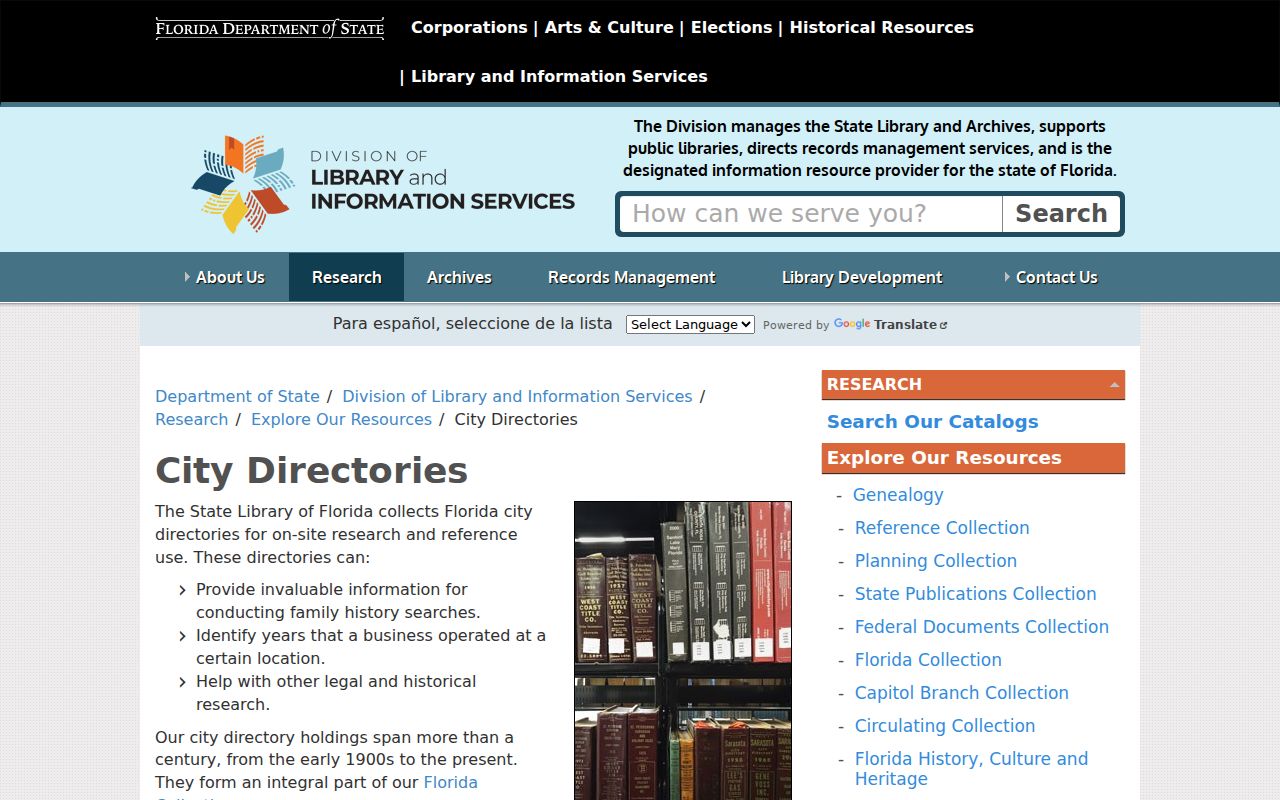
Use its catalog and reference service when a Lakeland year is absent from the local digital run or a related Florida city enters the trail.
Research Lakeland Directories at the Library
The Lakeland History Room at the main library is the local starting point for a missing volume or unclear address. Staff explicitly help with house and property research, family genealogy, newspapers, and obituaries. The room is at 100 Lake Morton Drive. Its hours are Monday through Thursday, 9 a.m. to 7 p.m.; Friday and Saturday, 9 a.m. to 5 p.m.; and Sunday, 1:30 to 5 p.m.
The official History Room collection page appears below.
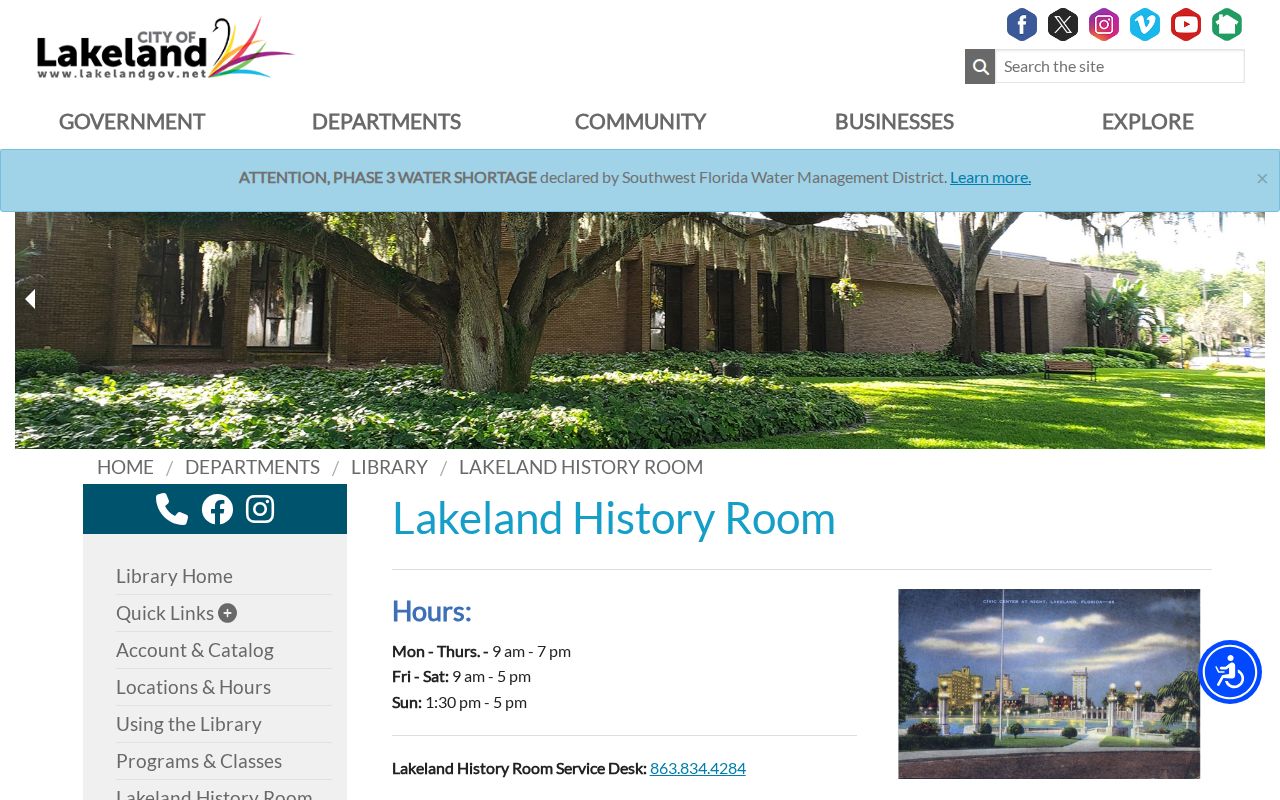
The room connects a directory entry with manuscripts, maps, building plans, photos, films, scrapbooks, yearbooks, newsletters, clippings, and other local material.
Ancestry is free inside the library. The service desk is 863-834-4284, and the History Room supervisor is reached at 863-834-4269. Ask staff to check the exact year, title page, reverse section, and nearby editions rather than assuming an online catalog lists the whole shelf.
Decode a Lakeland City Directory Entry
A typical entry compresses several facts into one line. In the local Polk-style runs, a surname leads. A given name or middle initial follows. A spouse may appear in parentheses, while “wid” can identify a widow and the deceased spouse. Work, an abbreviated employer, and the street address may finish the entry.
| Name | Surname first, then given name and often a middle initial. |
|---|---|
| Spouse | Often placed in parentheses; “wid” may precede a deceased spouse's name. |
| Work | Occupation or title, sometimes followed by an abbreviated employer. |
| Residence mark | “h” can mark home or householder, “r” residence or rooms, and “bds” boards. |
| Address | Street number and name, which should be checked against that year's street index. |
| Later details | Some editions add spouse or telephone information. |
Do not expand a code from memory. Photograph or save the abbreviation key from that volume. The publisher's symbols can change, and the entry identifies a listed role, not every person who shared the address.
- Criss-cross directory
- A section arranged by street and house number rather than surname.
- Householder index
- An address-led aid that points from a property to the listed person or household.
- Abbreviation key
- The publisher's legend for short forms, symbols, occupations, and residence marks in that edition.
Follow Lakeland Families Across Polk Editions
The 1928, 1931, and 1934 regional editions cover more than Lakeland. NARA's list identifies editions that also include Auburndale, Bartow, Fort Meade, Haines City, Lake Wales, Mulberry, and Winter Haven. A person who vanishes from the Lakeland alphabetical section may have moved only a few miles within Polk County.
Search the volume's full geographic scope before ending the trail. Keep the spouse name, occupation, and employer in view because these may remain steady after an address move. Then compare the new entry with a census, deed, newspaper item, or marriage record. Regional coverage is one of the most useful quirks on Lakeland's historical shelf.
Note: A regional edition can preserve a short Polk County move that a Lakeland-only name search would miss.
Search Lakeland's Digital History Collections
The Lakeland Public Library digital special collections add context that one printed line cannot hold. The collection includes local records, manuscripts, printed matter, maps, plans, photographs, films, recordings, scrapbooks, posters, clippings, newsletters, and ephemera. More than 10,000 images are held across the broader local collection.
The digital collection search is pictured below.
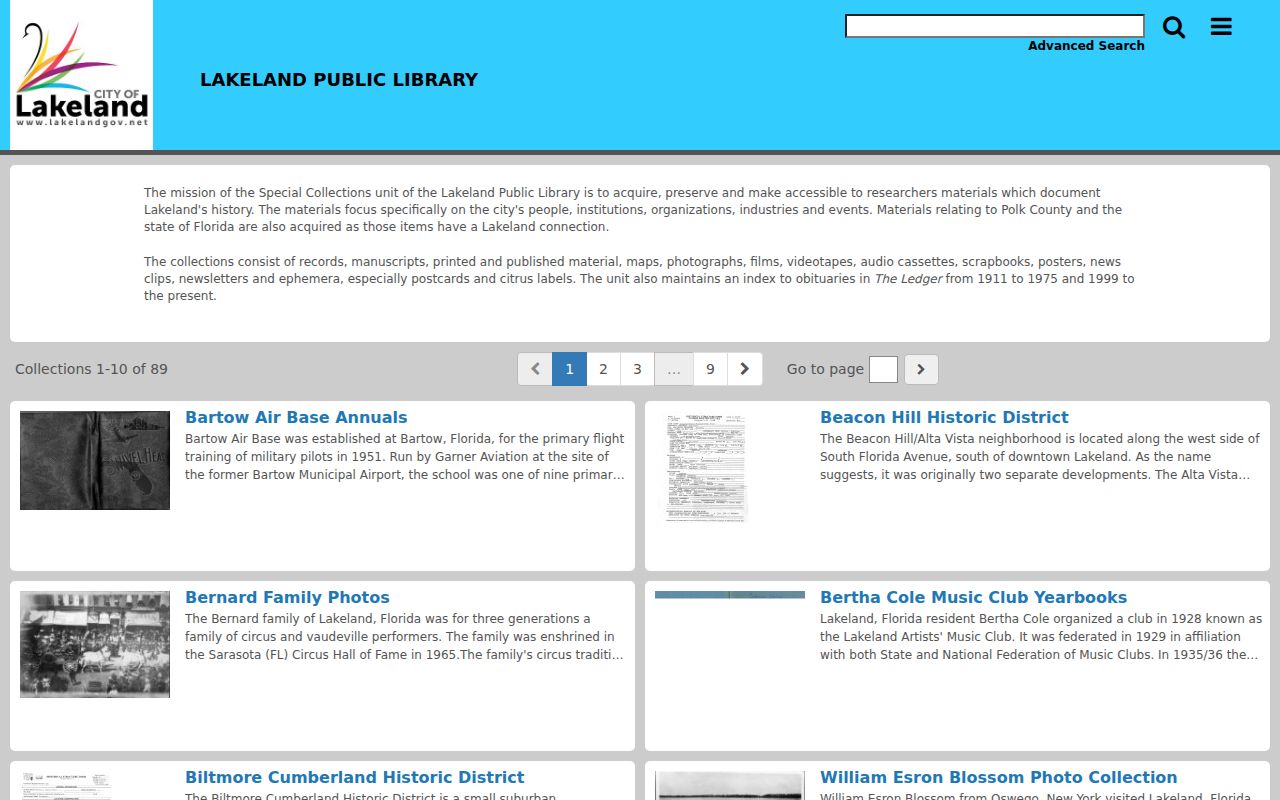
Search the exact street, business, employer, school, church, or neighborhood found in an entry to locate related images and documents.
Lakeland's rail and citrus past adds useful search terms. The History Room holds more than 200 citrus labels that name growers and firms. A label does not prove residence, but its exact company name can unlock local volumes, newspapers, and business records when an employer abbreviation is hard to read.
Bridge Lakeland Directories with Phone Books
Digitized white and yellow pages document segments from 1951 through October 1960. They can confirm a subscriber or business at an address and may help when a local volume is missing. They are not a count of all residents. Homes without service, people whose listing was omitted, and household members other than the subscriber can disappear.
Use a telephone book as a dated checkpoint between editions. Search both the personal name and the business name, then save the page date and heading. If a number or address changes, compare the next volume, deed, or newspaper notice before treating the change as a move.
Mind Lakeland's Ledger Index Gap
The Ledger obituary index covers 1911 through 1975 and 1999 to the present. The explicit 1976 through 1998 gap matters when someone stops appearing in a city directory or telephone book. An empty index result during those years does not mean there was no obituary. Search newspaper databases or microfilm instead.
An obituary can supply relatives, past homes, community ties, and a death date. Treat it as a locator, then verify a key event with vital, probate, church, or cemetery records. The indexed date can also lead back to the last directory appearance and help distinguish death from a move.
Polk History Center Extends the Shelf
The Polk County History Center occupies the former 1908 courthouse at 100 E. Main Street in Bartow. Its historical and genealogical library holds directories, tax rolls, cemetery records, maps, newspapers, books, periodicals, and microfilm. The repository also bridges the clerk's modern online cutoff with older county sources.
The official History Center page is shown below.
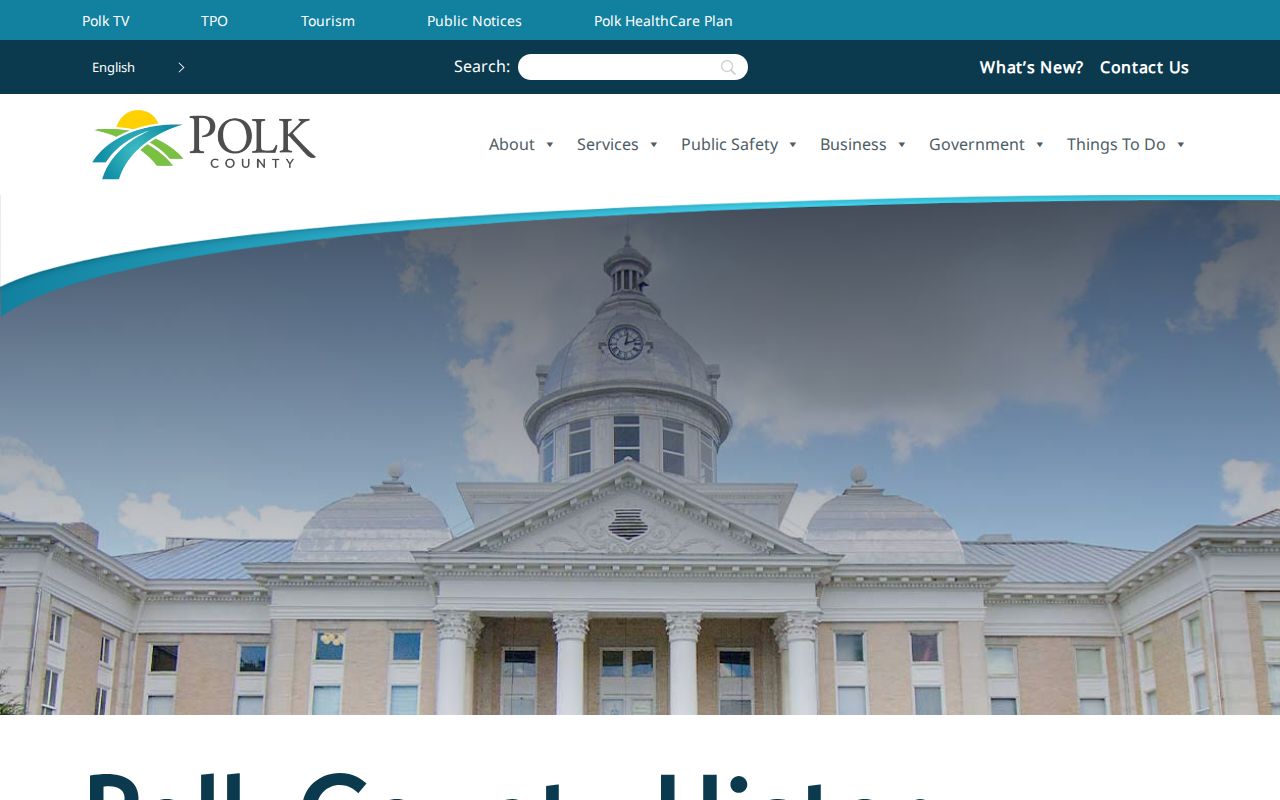
The old seat of county government now helps researchers connect names in printed directories to older deeds, tax rolls, marriage indexes, and local papers.
One finding guide describes a 1931 title-insurance case register and a 1958-59 hospital ledger with names, admission dates, days, and addresses. Confirm access rules before relying on sensitive ledger material. The History Center can be reached at 863-534-4386.
Trace Lakeland Families Across Directory Years
A sound family-history search uses each directory entry as a dated claim. Spellings, initials, spouse names, occupations, and street numbers all help distinguish two people with the same name. Search close years in both directions and write down every change.
- Choose a known year and find the person under each likely surname, maiden name, initial, and spelling variant.
- Record the spouse, work, employer, residence code, and exact address. Save the title page and abbreviation key.
- Check the editions just before and after. Use the reverse section, if present, to see who else was listed at that number.
- Pair directory entries with the 1920, 1930, 1940, or 1950 census household nearest in date.
- Check property deeds for ownership, since a directory occupant may not own the parcel.
- After a disappearance, use the Ledger index, newspapers, probate, marriage, and cemetery sources to test death or relocation.
The latest public full census is 1950. The 1960 schedules are due to open in 2032 under the federal rule. For a modern address-keyed view, shift to the Lakeland street directory rather than stretching an old volume beyond its date.
Read Lakeland Directory Omissions Carefully
Printed directories omit many women except as spouses or widows, children, institutional residents, rural families, seasonal residents, and people who declined canvassing. Segregated institutions and publisher bias can also understate Lakeland's Black community and other marginalized residents. Church, school, neighborhood, newspaper, and family collections can help repair that gap.
Telephone books add a different bias because they list subscribers, not all adults. A winter visitor may appear in one year and vanish in the next. A business address may be mistaken for a home. An occupation or employer may be abbreviated so sharply that the wrong firm seems likely.
A careful city directory search states the edition, page, exact printed text, and meaning assigned to each code. It treats absence as an open question. Two or more independent sources should support any claim about identity, residence, relationship, or a move.